
Table of Contents
Telehealth is not one type of visit.
Sometimes a patient needs a physician on a screen in real time. Sometimes they need to submit information, wait for a clinician to review it, and receive care without scheduling a live appointment.
Both are telehealth. But they create very different clinical workflows.
That distinction matters for digital health companies.
Choosing between synchronous vs asynchronous telehealth is not simply a decision about whether your platform should have video or chat. It affects provider utilization, patient experience, clinical workflows, reimbursement, staffing, and how efficiently a program can scale.
And for many digital health brands, the best answer is not choosing one.
It is knowing when to use each.
Synchronous vs. Asynchronous Telehealth: What’s the Difference?
The simplest distinction is timing.
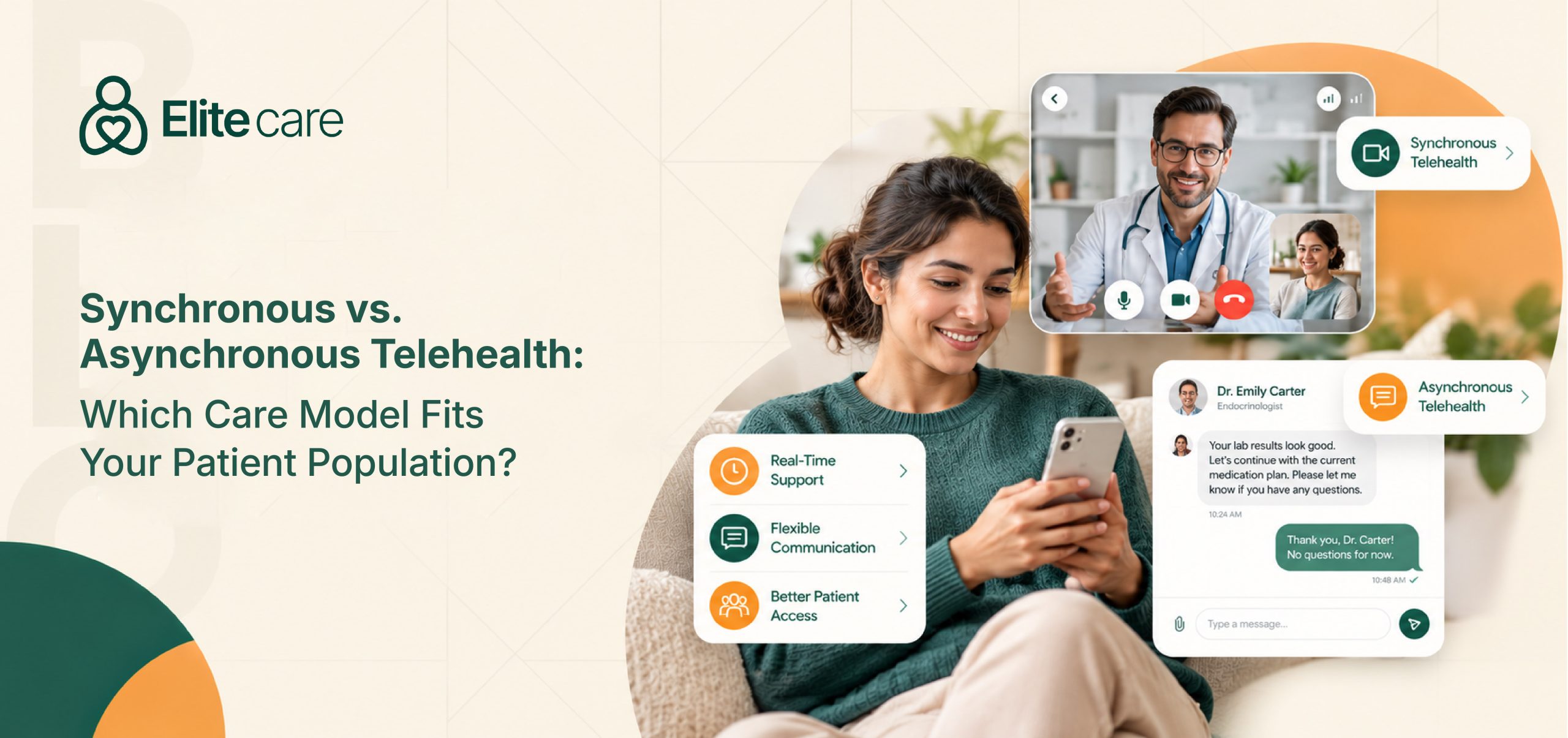
Synchronous telehealth happens in real time. The patient and provider interact through video or audio, similar to an in-person appointment.
Asynchronous telehealth, often called store-and-forward, allows the patient and provider to exchange information at different times. A patient may submit symptoms, photographs, medical history, questionnaires, or other information for a clinician to review later.
Think of the difference this way:
Synchronous:
Patient → waits for appointment → clinician evaluates → care decision
Asynchronous:
Patient → submits information → clinician reviews → care decision → patient receives response
Neither is automatically better.
The right model depends on what the patient needs and what the clinical program is designed to deliver.
When Synchronous Telehealth Makes More Sense
Live visits remain valuable when the clinician needs real-time interaction.
That can include:
- Complex clinical histories
- New or uncertain symptoms
- Conditions requiring detailed discussion
- Medication conversations
- Behavioral health
- Situations where clinical questioning needs to adapt in real time
- Cases where the provider needs immediate clarification from the patient
There is also a human element.
Some patients simply feel more comfortable discussing a new diagnosis or treatment plan with a clinician face-to-face, even when that face-to-face interaction happens through a screen.
For digital health businesses, synchronous care can also create a stronger sense of continuity between patient and provider.
But there is a tradeoff.
Every live visit requires two people to be available at the same time.
That creates a capacity constraint.
Where Asynchronous Telehealth Can Create Operational Leverage
An async telehealth model changes that equation.
Instead of matching a patient and provider to the same appointment slot, the patient can submit information when convenient and the clinician can review it within the program’s defined workflow.
HHS specifically identifies asynchronous telehealth as useful for patient intake and follow-up care, where providers review information submitted by patients to diagnose or treat an issue.
That can make asynchronous care particularly useful for workflows that are structured, repeatable, and clinically appropriate for review without a live conversation.
For example:
Patient intake → questionnaire → medical history → clinical review → treatment decision → follow-up
The patient does not necessarily need to spend 20 or 30 minutes waiting for a synchronous appointment at every stage.
That can reduce friction for both sides.
The Business Question: How Much Provider Time Does Your Model Require?
This is where the distinction becomes more interesting for digital health operators.
Imagine a program receiving hundreds of routine follow-up requests.
If every interaction requires a live video appointment, the company needs enough provider availability to handle every patient in a scheduled time slot.
An asynchronous workflow can allow clinicians to review appropriate cases in batches within a defined clinical workflow.
That does not mean async care requires less clinical oversight.
It means provider time can potentially be allocated differently.
The operational question becomes:
Does this clinical interaction require synchronous attention, or does it require clinical review?
Those are not always the same thing.
Is Asynchronous Telehealth Less Clinical?
No.
“Asynchronous” describes how information is exchanged, not whether a clinician is involved.
A patient may submit information asynchronously, but a licensed clinician can still review the case, make a clinical determination, document the encounter, and establish the appropriate next step.
HHS describes asynchronous direct-to-consumer telehealth as a model in which patients and providers exchange critical information without interacting in real time.
That distinction is important because some businesses treat async care as simply “chat support.”
That is too simplistic.
A properly designed asynchronous clinical workflow can be part of a structured care model.
The clinical standard still matters.
Which Model Is Better for Chronic Care Management?
There is no universal winner.
Chronic care is often where a hybrid telehealth model becomes particularly useful.
A patient with an established condition may not need a live appointment for every interaction.
Some parts of the care journey can potentially happen asynchronously:
- Routine follow-up information
- Patient-reported updates
- Review of certain test results
- Medication-related questions
- Structured check-ins
- Care-plan updates
- Administrative or clinical communication
Other situations may require synchronous interaction:
- New symptoms
- Significant changes in condition
- Complex medication decisions
- Clinical uncertainty
- Escalation
- Cases requiring a more detailed assessment
The result is a care pathway rather than a single modality.
Async handles appropriate routine touchpoints.
Sync handles interactions that benefit from real-time clinical evaluation.
That can create a more efficient operating model without forcing every patient into the same workflow.
Can a Telehealth Business Offer Both?
Absolutely.
In fact, many businesses should consider it.
HHS recognizes both synchronous and asynchronous modalities as options for direct-to-consumer telehealth.
The important part is deciding where each modality belongs.
A digital health program might use:
Async for:
Intake → routine follow-up → information collection → certain clinical reviews
Sync for:
Initial consultations → complex cases → escalations → situations requiring real-time discussion
The technology should support that clinical strategy rather than determine it.
That distinction matters.
You do not want a business choosing video because its platform has video.
You want the clinical model to determine the technology.
Is Asynchronous Telehealth Reimbursable?
Sometimes.
This is one area where founders should be careful about broad claims.
Medicare has specific pathways for non-face-to-face patient-initiated online evaluation and management services, including certain e-visits through patient portals. CMS maintains a current list of services payable under the Medicare Physician Fee Schedule.
Medicaid is more variable.
CCHP’s Fall 2025 review found that 40 state Medicaid programs reimburse for store-and-forward services, but the scope varies. Some states impose restrictions based on service, specialty, provider type, technology, or billing pathway, while other states do not reimburse certain asynchronous services.
So the right question is not:
“Is asynchronous telehealth reimbursable?”
It is:
“Is this specific asynchronous service reimbursable by this payer, in this state, under this billing pathway?”
That is a much safer operating question.
Is Asynchronous Telehealth Compliant?
It can be.
But asynchronous does not create a compliance exemption.
The program still needs to account for applicable state telehealth laws, provider licensure, patient location, standard of care, privacy and security, documentation, prescribing requirements where applicable, and payer requirements.
State rules can differ considerably.
CCHP notes that some states define telehealth in ways that require real-time or interactive communication, which can effectively exclude certain store-and-forward services from their telehealth definitions or reimbursement policies.
That means a national digital health business cannot assume that an async workflow approved for one state automatically works everywhere.
Are Asynchronous Telehealth Visits Accepted by State Medical Boards?
There is no single nationwide yes-or-no answer.
State medical boards and state regulators operate within state-specific laws and standards of care. Whether a particular asynchronous interaction can constitute an appropriate telehealth encounter depends on the circumstances, applicable state law, clinical service, provider, and standard of care.
That is why “async is legal” is too broad a statement for a national telehealth business.
The better approach is to evaluate the intended clinical workflow state by state.
A program should know:
- Where the patient is located
- Where the provider is licensed or authorized to practice
- What service is being delivered
- Whether the state recognizes the modality
- What standard of care applies
- What documentation is required
- Whether prescribing is involved
- Whether the payer recognizes the service
For a company operating nationally, this becomes part of the infrastructure rather than a one-time legal review.
The Real Advantage of a Hybrid Model
The biggest mistake is designing the patient journey around the technology instead of the care.
A video-first company may force routine patients into unnecessary live appointments.
An async-only company may force complex patients into workflows that are not appropriate for asynchronous care.
A hybrid model can be more practical.
Consider a patient journey:
1. Intake
Patient submits history, symptoms, medications, and relevant information asynchronously.
2. Clinical review
A provider reviews the submitted information.
3. Decision point
Straightforward cases proceed through the appropriate workflow.
4. Escalation
Cases requiring real-time assessment move to a synchronous appointment.
5. Treatment and follow-up
Appropriate follow-ups can use asynchronous communication, with synchronous care available when clinically necessary.
The technology is now serving the clinical model.
Not the other way around.
What This Means for Provider Capacity
Provider capacity is one of the biggest constraints in digital healthcare.
A synchronous-only model ties capacity directly to appointment slots.
An appropriately designed async workflow can allow some clinical work to happen outside fixed appointment windows.
That can matter as patient volume grows.
The question becomes less about:
“How many appointments can we schedule?”
and more about:
“How much clinical demand can our operating model safely absorb?”
That is a much more useful metric for a scaling healthcare company.
The Infrastructure Has to Support Both
Offering both modalities is not as simple as adding a video button and a messaging feature.
The underlying infrastructure needs to connect:
Patient intake → clinical triage → provider assignment → synchronous or asynchronous pathway → documentation → labs or other services → prescribing where appropriate → follow-up
If those systems operate separately, the patient experience can become fragmented.
If they work together, the modality becomes almost invisible to the patient.
They simply receive the type of care appropriate to their situation.
That is the goal.
How Digital Health Brands Should Choose Their Model
Before deciding between synchronous and asynchronous care, founders should ask five questions.
1. What does the patient actually need?
Start with the clinical problem, not the technology.
2. Which interactions require real-time evaluation?
Identify where synchronous care adds clinical value.
3. Which interactions can safely happen asynchronously?
Look for structured, repeatable workflows where real-time interaction is not necessary.
4. What do state and payer rules allow?
Do not assume national uniformity.
5. Can the infrastructure move patients between both?
This is often the most important question.
A patient should not get trapped in an async workflow when their case needs a live consultation.
Likewise, a routine interaction should not automatically consume a full synchronous appointment slot.
Where Elite Care Fits
For digital health brands, building both synchronous and asynchronous capabilities internally can mean building far more than a patient-facing telehealth interface.
The clinical operation has to support the workflows behind it.
Elite Care provides virtual healthcare infrastructure that can help brands build and operate clinical programs without treating provider capacity, clinical workflows, technology, and operational execution as separate pieces.
For companies considering an async telehealth model, the goal should not be to replace synchronous care.
It should be to build a smarter care pathway where each modality is used where it makes the most sense.
Because the strongest telehealth model is not the one with the most technology.
It is the one that matches clinical need with operational capacity.
Get in touch!
Frequently Asked Questions
Is asynchronous (chat-based) telehealth reimbursable and compliant?
It can be, but reimbursement and compliance depend on the service, state, payer, provider, and clinical circumstances. Medicare has specific payment pathways for certain patient-initiated online evaluation and management services, while Medicaid policies vary considerably by state. CCHP’s latest review found 40 state Medicaid programs reimbursing some form of store-and-forward care, with limitations in some states.
What’s the difference between synchronous and asynchronous telehealth visits?
Synchronous telehealth happens in real time, usually through video or audio. Asynchronous telehealth allows the patient and provider to exchange information at different times. HHS also refers to asynchronous care as “store-and-forward” telehealth.
Which telehealth model is better for chronic care management?
Neither is universally better. Chronic care can benefit from a hybrid approach, using asynchronous workflows for appropriate routine communications and follow-up while reserving synchronous visits for complex cases, new concerns, clinical uncertainty, or situations requiring real-time assessment.
Can a telehealth business offer both synchronous and asynchronous care?
Yes. HHS recognizes both modalities for direct-to-consumer telehealth. The important consideration is designing clear clinical workflows that determine when each modality is appropriate and ensuring those workflows comply with applicable state, federal, clinical, and payer requirements.
Are asynchronous telehealth visits accepted by state medical boards?
There is no universal national rule. State laws and regulatory approaches vary, and some states place limitations on store-and-forward care or define telehealth around real-time interaction. A national telehealth business should evaluate its specific asynchronous workflow against the requirements of each state in which it operates.