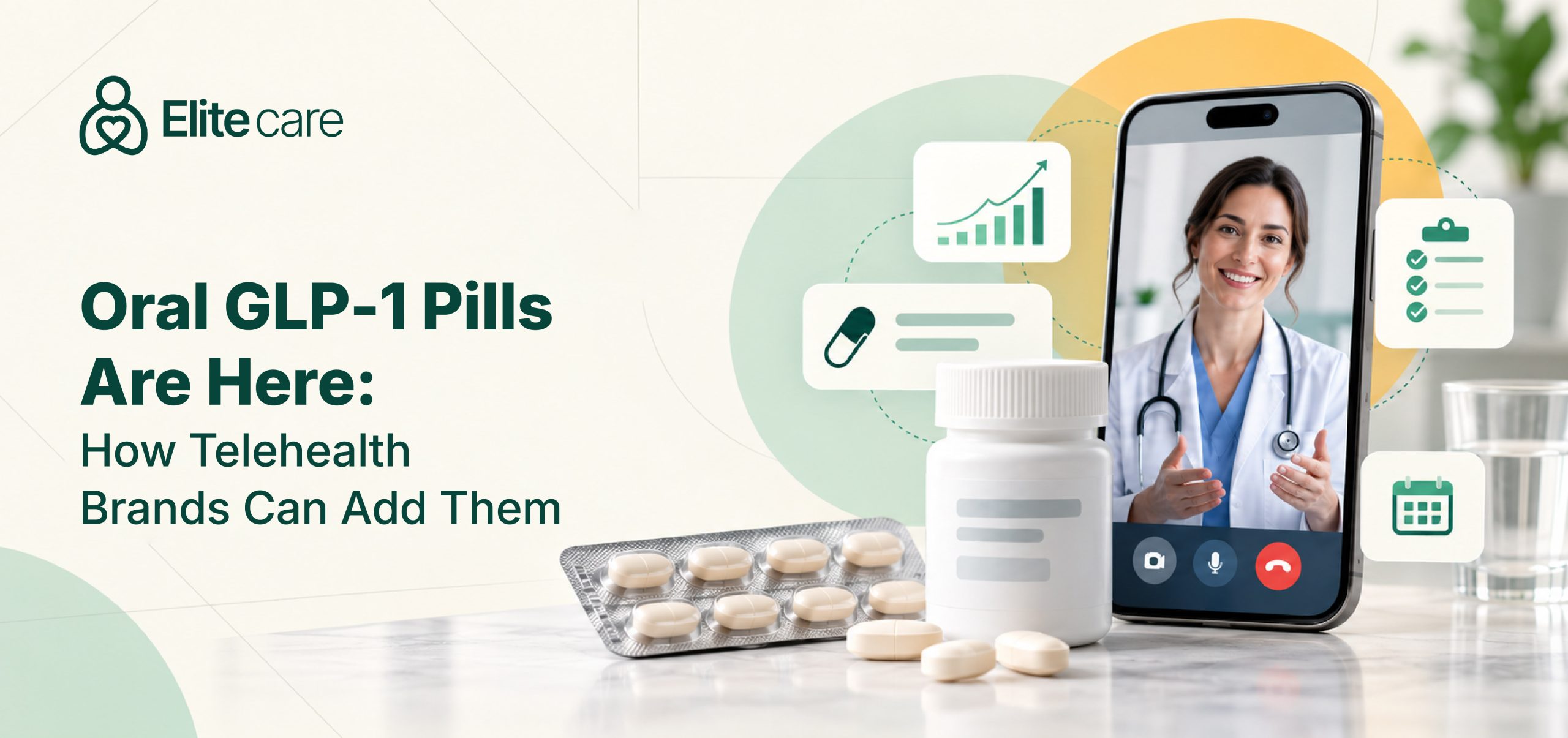
Oral GLP-1 medications give telehealth businesses another way to build weight-management services without relying exclusively on injectable treatments. The practical question is how to connect patients with appropriate prescribing care, medication access, and ongoing support without building an entire clinical operation from scratch.
For founders, clinic owners, and affiliate marketers, this is a business opportunity, but it isn’t simply a matter of putting a pill on a website.
You’ll need a reliable way to connect patients with licensed providers, support prescriptions, explain treatment options accurately, and keep marketing claims within the rules.
Here’s what to consider before adding oral GLP-1 medications to your telehealth business.
Which oral GLP-1 medications should telehealth brands know about?
Two FDA-approved oral medications are particularly relevant to the current weight-management market: Wegovy pill (semaglutide), approved in December 2025, and Foundayo (orforglipron), approved in April 2026. Confirm the latest FDA approval records and prescribing information before publication.
Both provide an oral option for eligible patients, but they aren’t interchangeable products. Their prescribing information, administration instructions, precautions, and clinical considerations differ.
For a telehealth operator, the important question isn’t which medication is universally better. It’s how your clinical workflow can support appropriate prescribing and help patients understand the differences.
Wegovy pill vs. Foundayo: What’s the difference?
| Consideration | Wegovy pill | Foundayo |
| Active ingredient | Semaglutide | Orforglipron |
| Manufacturer | Novo Nordisk | Eli Lilly |
| Medication type | Oral GLP-1 receptor agonist | Oral GLP-1 receptor agonist |
| Administration | Specific fasting and administration instructions apply | Can be taken with or without food, according to manufacturer information |
| Patient education | Explain the required administration routine and timing | Explain the product’s prescribed dosing schedule and safety instructions |
| Telehealth opportunity | Build support around prescriptions, administration instructions, and follow-up | Build support around prescriptions, tolerability, adherence, and follow-up |
Sources: the manufacturers’ official resources: Wegovy and Foundayo.
Important: Verify the current FDA-approved labels for each product before publishing this comparison. The administration details above are a high-level summary, not prescribing instructions.
For businesses, the difference matters because patient education doesn’t end when a prescription is issued. People need clear instructions, a way to ask questions, and appropriate clinical follow-up.
Why do oral GLP-1 medications fit the telehealth model?
An oral medication creates another way for eligible patients to access weight-management care. It also gives telehealth businesses an opportunity to build a more complete service around the medication itself.
Consider what happens beyond the prescription.
A patient may need an initial evaluation, help understanding the treatment plan, follow-up appointments, support with side effects, and guidance if the treatment needs to change. Those needs create an ongoing care relationship rather than a one-time transaction.
For operators, three areas deserve attention.
Patient experience: Clear onboarding, easy appointment scheduling, and understandable medication instructions can make the process less confusing.
Continuity of care: Follow-up workflows give providers opportunities to assess progress, review tolerability, and make appropriate clinical decisions.
Retention through real value: When several businesses provide access to the same branded medication, price alone may not distinguish them. Responsive support, practical education, and consistent follow-up can make the experience more useful.
That doesn’t mean promising better outcomes or guaranteed weight loss. It means building a service that supports patients throughout treatment.
The same infrastructure considerations apply to other specialty services. Our guide to TRT and HRT telehealth programs explores how digital health brands can build services around specialized clinical care.
How can a telehealth business add oral GLP-1s?
There isn’t one setup that works for every company. Your best option depends on your existing clinical capabilities, budget, operational resources, and business model.
Option A: Build your own prescribing operation
If you already operate a healthcare organization, you may be able to integrate oral GLP-1 care into your existing services.
You’ll need appropriately licensed clinicians, patient intake and evaluation workflows, prescribing processes, pharmacy arrangements, documentation, and follow-up procedures.
You’ll also need to understand the rules that apply in each state where you serve patients.
This model offers more direct control over the patient experience. It also places more operational responsibility on your organization.
Option B: Work with a nationwide provider network
You don’t necessarily need to recruit and manage every clinician yourself.
A provider network can help a telehealth business connect with appropriately licensed clinicians and establish workflows for virtual evaluations and ongoing care.
This can be useful for founders who have a brand, audience, or existing patient community but don’t have a clinical team in every target state.
Before choosing a partner, read our guide on what to look for in a 50-state telehealth provider network to understand the provider coverage, clinical workflows, and operational support your business may need.
A white label telehealth provider network may help reduce the burden of assembling clinical operations independently. However, confirm exactly which responsibilities the partner handles and which remain yours.
Option C: Use a white-label telehealth platform
A white label telehealth platform can bring branded patient experiences and clinical technology together under one operating model.
Depending on the provider, this may include patient intake, appointment scheduling, virtual consultations, electronic health records, prescription workflows, and support for pharmacy coordination.
For companies exploring White Label Telehealth for Healthcare Brands & Providers, the appeal is straightforward: you can focus on your brand, audience, and patient experience while working with an established infrastructure partner.
But white-label doesn’t mean responsibility-free. Your organization still needs to understand its role in advertising, patient communications, privacy, and any applicable healthcare obligations.
Ask for a clear breakdown of services, fees, ownership, and responsibilities before signing an agreement. Don’t assume every platform includes prescribers, pharmacy access, or medication fulfillment.
What about retail pharmacy partnerships?
Retail pharmacies may be part of the medication-access model, depending on the product, prescription, availability, and business arrangement.
However, a pharmacy relationship alone doesn’t provide the full telehealth operation. You’ll still need an appropriate clinical evaluation process and a way to support patients before and after treatment.
How do you start a GLP-1 telehealth business?
If you’re researching how to start a GLP-1 telehealth business, begin with the operating model—not the marketing campaign.
Step 1: Define your audience. Decide whether you’re serving patients directly, adding weight management to an existing clinic, or partnering with an established healthcare business.
Step 2: Choose your clinical model. Determine whether you’ll use your own clinicians, a provider network, or a white-label arrangement.
Step 3: Map the patient journey. Plan the process from initial inquiry through intake, provider evaluation, prescription decisions, pharmacy coordination, and follow-up.
Step 4: Confirm medication access. Verify product availability, pharmacy arrangements, prescribing workflows, and who communicates with patients about fulfillment.
Step 5: Build patient support. Decide how patients can ask questions, report side effects, schedule follow-ups, and receive appropriate clinical guidance.
Step 6: Review marketing before launch. Check product claims, landing pages, affiliate content, disclosures, and advertising-platform requirements.
There is no single launch cost that applies to every business. Costs depend on the platform, provider arrangement, technology, staffing, pharmacy setup, marketing, and other operating expenses. Request a detailed quote rather than relying on a generic startup-cost estimate.
What should your GLP-1 telehealth compliance checklist include?
Compliance should be built into the operating model from the start.
FDA and medication information
- Use current FDA-approved prescribing information when describing Wegovy pill and Foundayo.
- Do not imply that the two products are identical or interchangeable.
- Don’t promise a specific amount or rate of weight loss.
- Avoid unsupported safety, efficacy, or superiority claims.
- Make sure medication information accurately reflects the approved indication, limitations, warnings, and precautions.
Start with the FDA’s drug database and the current manufacturer prescribing information.
State licensing and clinical operations
- Confirm that clinicians are appropriately licensed for the states where patients are located.
- Establish an appropriate clinical evaluation process.
- Define responsibility for documentation, prescribing, follow-up, and escalation.
- Review applicable telehealth, privacy, prescribing, and professional practice requirements.
- Confirm that pharmacy arrangements and prescription workflows comply with applicable requirements.
A nationwide brand doesn’t automatically have nationwide authority to provide every service. Coverage must be confirmed for the actual clinical model.
LegitScript and advertising requirements
LegitScript certification requirements depend on the business model and the applicable platform or partner rules. Healthcare advertisers should confirm whether certification is required for their specific activity before launching campaigns.
Certification isn’t a substitute for compliance with applicable laws, accurate claims, or responsible clinical operations.
What can you and can’t you say in GLP-1 marketing?
Marketing should help people understand the service without making promises the clinical team can’t guarantee.
| Safer direction | Avoid |
| “Explore whether prescription weight-management care may be appropriate for you.” | “Everyone qualifies.” |
| “Connect with a licensed provider for an individual evaluation.” | “Get a prescription guaranteed.” |
| “Learn about available FDA-approved oral treatment options.” | “The best weight-loss pill for everyone.” |
| “Care includes provider evaluation and follow-up.” | “Lose a guaranteed number of pounds.” |
| “Treatment decisions depend on individual clinical needs.” | “No risks, no side effects.” |
These examples are general marketing guidance, not a legal determination. Claims must be assessed in context, including the landing page, visuals, testimonials, disclaimers, and overall impression.
Avoid implying that FDA approval guarantees a particular outcome or that every person is eligible for treatment.
What should GLP-1 telehealth affiliates know?
A GLP-1 telehealth affiliate program can help a healthcare brand reach relevant audiences through publishers, creators, wellness communities, and referral partners.
But affiliates need clear rules. A brand can face problems when partners make unsupported claims, even if those claims weren’t written by the company’s internal marketing team.
How does an affiliate arrangement work?
Typically, the healthcare business provides approved messaging, referral links, and program terms. The affiliate directs interested people to the appropriate service. The healthcare provider then handles clinical evaluation and determines whether treatment is appropriate.
Compensation structures vary. Don’t assume a particular commission, payment model, or eligibility rule unless the program has confirmed it.
Which claims should affiliates use?
Affiliates should stick to approved, substantiated messaging. They can explain the service, describe how to request an evaluation, and direct people to official product information.
They should not guarantee prescriptions, promise specific weight-loss results, claim a medication is risk-free, or suggest that everyone is a suitable candidate.
What disclosures are required?
If an affiliate receives payment, commissions, free products, or another benefit for promoting a service, that relationship should be disclosed clearly and conspicuously.
The disclosure should be easy to notice and understand—not buried in a profile, a long caption, or a block of hashtags.
Brands should provide written affiliate guidelines, approved claims, prohibited claims, disclosure examples, and a process for reviewing or removing problematic content.
Ready to build your oral GLP-1 telehealth offering?
You don’t have to assemble every part of a telehealth operation independently.
Elite Care Health helps healthcare businesses explore provider-network and telehealth infrastructure options for building virtual-care services. If you’re considering adding oral GLP-1 care, start by mapping your clinical model, target states, patient workflow, and operational needs.
Contact Elite Care Health to discuss your business model and the infrastructure it may require.
Frequently asked questions
1. What oral GLP-1 pills are FDA-approved for weight loss right now?
Wegovy pill (semaglutide), approved in December 2025, and Foundayo (orforglipron), approved in April 2026, are the two products covered in this guide. Confirm current FDA records and approved indications before publication.
2. Can telehealth companies prescribe oral GLP-1s?
Telehealth companies can facilitate care through appropriately licensed clinicians when applicable requirements are met. A clinician must evaluate the individual patient and determine whether prescribing is appropriate.
3. How can a telehealth brand add oral GLP-1s without building its own provider network?
A brand may partner with a provider network or a white-label telehealth platform. It should confirm provider coverage, clinical responsibilities, pharmacy arrangements, and follow-up support before launch.
4. Do telehealth brands need LegitScript certification to advertise GLP-1s?
It depends on the business model and the requirements of the advertising or business partner involved. Brands should verify the applicable certification requirements before running campaigns.
5. Can affiliates promote GLP-1 telehealth services, and what claims are allowed?
Affiliates can promote services within the program’s rules, using accurate, substantiated claims and clear disclosures of material relationships. They should not promise prescriptions, guarantee weight loss, or make unsupported medical claims.